Thursday, October 23, 2014

Weekly Tech Post 10/24

Physical Key Created as an Identity Lock

     Google has recently begun creating a USB device that holds a users information. This USB would be used as a type of identity holder and is said to be extremely secure. The key can be used either monthly or daily and can connect to any computer or Google account. Instead of putting in information every time one uses a computer, he or she can simply insert the USB and their login and password will be entered. 
     This key is planned on being sold for less than $20. The change from "typed in logins" to keys will diminish the amount of accounts that are hacked through passwords. Key USB devices are becoming a more common way of opening accounts and securing information. 
     The Key USB is the most secure option due to the inability of hacking the chip that is inside the key. Many hackers intercept logins through text messages or breaking into cellphones, however, one would not be able to hack into the Google Key unless they physically have the key. You can see the article here.

Thursday, October 9, 2014

Weekly Tech Post 10/10

OLED Lighting Sheets Use Half the Energy of Lightbulbs
Researchers have recently been enhancing a stronger form of light energy. The Organic LED light-sheets have had positive feedback in many areas. Although the OLED lights are very costly (one OLED lamp costing around $9,000), many manufacturers have been attempting to recreate the same energy with lower costing products. Some companies, such as OLED-Works, have even made the OLEDs on plastic sheets.  These artificial lights give off a combination of red, green, and blue light. Enhancing these sheets of light can positively influence the entire country. Lighting is 20% of all electricity in the United States. This low-costing and energy efficient form of light can reduce the entire cost of lighting in housing, buildings, or even in public parks. The article on OLED lights can be seen here.

Thursday, October 2, 2014

10/3 Weekly Tech Post

     LTE Direct Quickly Gets Information Without the Need For Cell Towers

      Opposed to the current cell phones that require cell towers to connect to information, researchers have begun developing a phone that does not require the usage of cell towers. Many cell phones that use LTE are supposed to quickly go through cell towers to get the user to whatever app or contact they are trying to get to. However, Qualcomm has created a cell phone protocol that will be able to pass cell towers altogether. Instead of making large, bulky, and unattractive towers, beacons will be created and set up in stores or businesses in certain areas.
   With these new beacons, we are able to diminish the dependence on cell towers; possibly even erasing cell towers completely. This new technology implanted into upcoming phones will allow society to turn away from cell towers that give off harmful rays and radiation.
        The technology will be created in a way that saves the user battery life, while searching for beacons to connect to. Despite the similar iBeacon created by Apple (shown above), this new technology will reach farther distances and will not be used from bluetooth settings. Also, the protocol will not send notifications (as seen in the picture to the right), however, it will send a type of wifi signal out to cell phones in order for them to be used proficiently. The protocol has been very successful and will only need simple work on the accessibility for large groups of users before being released into the public.


http://www.technologyreview.com/news/530996/future-smartphones-wont-need-cell-towers-to-connect/

Monday, September 29, 2014

Do-Now 9/29

    An editorial is a written piece of work that gives an opinion or standpoint about a certain issue. An article may contain quotations or citations, however, the article focuses around a single opinion of the editor. Many believe that Wikipedia is a form of editorials; giving more opinions than factual information. Teachers specifically tell us that Wikipedia is not a reliable source and do not suggest Wikipedia as a data base for helpful information. Wikipedia is very well known as a website where anyone is able to contribute information.
     Many teachers do not allow us to use Wikipedia for any school papers. Although is helpful for definitions and simple things, one should not rely on Wikipedia for factually correct information. Teachers stress the ability for random people to contribute any type of information, correct or not. I, personally, have not questioned the usage of Wikipedia. I know that Wikipedia is not always completely true, and always double check certain information that I find off the website.
     After reading this article about Wikipedia, I have not changed my mind about the website. I never relied on it as a primary source and only use the site for quick, simple information. Personally, Wikipedia should only be used by people who need opinionated answers. The website should not be considered a type of primary source and should never be used as a useful website for finding information.

Thursday, September 25, 2014

Motorized Pants Help Soldiers and Stroke Victims 
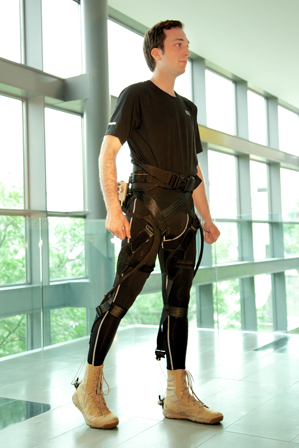
Exosuit     The newly Harvard-created Exoskeleton allows many people to find the support they need in every day life. The lightweight, battery powered machine can be used to support the wearer and allow them to carry heavier objects over longer distances. It propels the legs forward without effecting the normal human gait. 


     The exoskeleton mimics the human limb by using nylon mesh, cables, and sensors to connect directly to muscles, tendons, and nerves. Although it cannot help people who have lost full usage of their legs, it can still greatly improve the lives of some. For example, those who encounter muscle weaknesses from strokes find the research of exoskeletons quite useful. The machine can help weak people walk more easily or help healthy people carry heavier objects. The potential for this machine varies from supporting soldiers, assisting the elderly, rehabilitating children or adults, and easing the physical struggles of firefighters or paramedics. Although the machine is only a recent protocol, the exoskeleton is being largely researched and has many updates before its released into the public. 


http://www.technologyreview.com/news/530751/motorized-pants-to-help-soldiers-and-stroke-victims/

Wednesday, September 17, 2014

Web 2.0: Multimedia Blog Pre- Posting


     One course that I am taking this year is English IV Honors and it is taught by Ms. Millar.  You can see her website if you click here. I expect to learn about various British authors and writers. So far, we have learned the history about the Anglo-Saxon Time Period and the Medieval Time Period. In addition to learning about the history behind the literature, we also learned about various authors; including The Venerable Bede, Geoffrey Chaucer, and Beowulf. 
     As an honors class, our grading policy is very strict. The grading policy that Ms. Millar uses is a 45% projects, 45% tests, 5% homework, and 5% classwork/ participation. What I enjoy the most about this class is that we learn about British poets and authors rather than American poets and authors. It is refreshing to be focused on a different nation's literature after constantly learning about American literature. 
     Although our class is mainly taught through a textbook, Ms. Millar uses various technologies as teaching-tools. Through certain websites she was able to create crossword puzzles, word searches, and quizzes that were used as review games. I enjoy the usage of different technologies rather than being taught out of a textbook.  Her website also includes videos and projects that her students created, you can see one if you click here. You can see the rest of her videos if you click here. 

Monday, September 15, 2014

Educational Technology and Copyright Law

From this article, I learned what copyrighting is and how it has affected students and teachers. Copyrighting protects the plagiarism of literary, written, artistic, musical and other types of works.
When someone copyrights their own work, they are entitled to four things:
1. Reproduce the copyrighted work
2. Display the work publicly
3. Create works based off of their work
4. Distribute copies of the work
Some images are licensed and allows people to reuse their photos. However, the site requires the user to give photo credit to the photographer.


http://teachamazing.com/educational-technology-and-copyright-law/